• About
  • Services
  • Portfolio
  • Contact

Content Trends

Content Marketing, SEO and Digital Marketing

  • Home
  • Why Content Marketing?
  • SEO
  • Blogging Tips
  • Social Media
  • Newsletter

The Dos and Don’ts of Content Marketing [Slideshow]

November 29, 2012 by Gazalla Gaya

Content Marketing is a buzz word these days and I’d like to share this presentation with you, dear readers, since the topic revolves around content marketing best practices. I originally created this presentation for my local Chester County Internet Marketers group meet-up. We meet once every month for a lively, active discussion on Social Media and Content Marketing.

The first few slides deal with the definition and the main objectives of content marketing. The next few slides go into the dos of content marketing, some of which include:

  1. Know who your client is with the help of Personas
  2. WIIFM (Speak to their needs)
  3. Provide valuable info.
  4. “Good content shares or solves; it doesn’t hawk your wares or push sales-driven messages. It provides value by positioning you as a reliable and valuable resource.” – Ann Handley of Content Rules
  5. Define and answer your customers questions
  6. Provide many different types of content
  7. Create a sense of community
  8. Allow your content to have wings
  9. Set up a listening dashboard (Goolge Readrer, Google Alerts, twitter.com, relevant blogs)
  10. Measurement and metrics so you know what’s working

The don’ts include:

  1. Constantly talking about your brand and excessive self promotion which is a surefire way of turning off your customers. Content marketing, when done right is about your customers’ needs and wants.
  2. Making it difficult to understand what you offer
  3. Not doing anything to engage your prospects and customers

The last few slides look at content marketing best practices (or dos) for different types of content such as blogs, newsletters, white papers and eBooks.

This presentation is best watched in Fullscreen mode. Here’s the presentation:

Contentmarketing from Gazalla Gaya

Filed Under: Content Marketing Tagged With: content marketing best practices, dos and don's of content marketing

20+ Awesome, Free Resources for All Content Writers

November 6, 2012 by Gazalla Gaya

As online content creators, editors and marketers, it’s our job to keep up with the rapidly evolving field of content marketing. Content creators today, need to have a broad range of skills. In addition to our writing and editing skills, we need to be general savants in:

  • Content and brand strategy
  • Social media
  • Seo
  • Content marketing
  • Coding and web layout
  • User experience design and basic web design
  • Web development
  • Analytics
  • The resources below are excellent primers in all these relevant fields. They contain tutorials, training videos, whitepapers, case studies and eBooks created by industry leaders. The best part is that they are all free!

    Grammar and Writing Resources

    1. Yahoo style guide is simple to use. Since it’s already created for you, it saves you the time and effort required to develop your own style guide. All you have to do is follow the style conventions. Ap Stylebook online is one resource that requires a small annual fee of $25 to join but is an indispensable tool and needs to be included in this list.
    2. Dictionary.com and MerriamWebster.com are essential dictionary resources for all content creators. Synonym.com is a great resource when you’re searching for alternate terms. Using synonyms instead of repeatedly using the same keywords is also recognized as an seo best practice .
    3. Purdue University’s OWL (Online Writing Lab): The Online Writing Lab (OWL) at Purdue University houses writing resources and instructional material that help with general writing skills, grammar and punctuation.
    4. Writers workshop addresses common problems in writing such as dangling modifiers, homophones, run-on sentences and sentence fragments. A quick read of the workshop’s everyday grammar will strengthen your grammar and consequently your writing abilities.
    5. Daily Writing Tips: Get writing tips sent to your inbox, daily. Topics range from grammar to punctuation, from spelling to usage and vocabulary.

    SEO Resources

    6. Search Engine Land is an excellent resource to catch up on the latest seo news. Danny Sullivan, the editor in chief, is an established name in seo circles and is known to regularly and accurately predict future seo trends.
    7.Moz is also another excellent resource given the fact that their beginners guide is the de facto beginners guide to seo.

    Content Marketing

    8. Hubspot’s Inbound Marketing Certification course is an excellent course on inbound marketing and it’s free! The course curriculum includes 18 classes on inbound marketing from blogging, to seo to social media, it covers the entire spectrum of subjects on inbound marketing but the best part is that these courses are taught by heavy weights in their respective fields. Ann Handley, Rand Fishkin, Guy Kawasaki and Avinash Kaushik are some of the contributors.
    9. Content Marketing Institute has several whitepapers, case studies, interviews with prominent personalities. Another excellent resource is Copyblogger.

    Content Strategy

    Content Strategy is slowly emerging as a necessary field to administer, develop and plan all content for large corporate web sites.
    10. Brain Traffic: Kristina Halvorson is a leading authority on content strategy and her blog is extremely educational.
    11. The Content Wrangler: Scott Abel, the founder of the Content Wrangler is a leader in the field of content strategy. He also runs a LinkedIn group called the Content Wrangler Community. It’s an active group and the discussions also teach you about content management, content quality and content standards.

    Information Architecture

    12. The Information Architecture Institute has a ton of information for newcomers looking to learn more including a library, tools and a job board.
    13.The Nielson group has a comprehensive list of reports, whitepapers and guidelines that underline strategies to enhance the user experience. The topics range from the mobile user experience to ecommerce user experience to site-map usability.Useit.com is Jacob Nielson’s website on basic usability guidelines. The site includes useful videos, books and reports.

    WordPress help

    14. Kristi Hines 70+ Resources to Start a WordPress Blog : Kristi Hines blog, kikolani.com, on blogging and blog marketing is excellent and a must read for content creators. She has outdone herself with this remarkable primer on everything you need to know to create a WordPress blog.
    15. WP Beginner is a blog that serves as a beginner’s guide for WordPress users.

    Web Coding Resources

    16.W3 schools is a great resource for those tech savvy content creators who like to have some control over their site layout. W3 schools have excellent tutorials for everything from basic HTML to PHP to programming languages such as SQL and ASP
    17.Codecademy has some great basic tutorials for people looking to get started with coding.

    Images

    18.Flickr Creative Commons license: If you do an advanced search on Flickr with the option of creative commons checked, you could find some really cool pics. The only thing to remember is to give attribution based on the type of creative commons license you get.
    19. Free digital photos.net: The current picture for this post is from freedigitalphotos.net. True to their name, a pic of this size is free, anything larger does require a small fee.

    Analytics

    20 . Occam’s razor: Avinash Kaushik is the # 1 authority today on web analytics and reading his blog is as good as getting a good tutorial on the different ways that you can use analytics to help your website gain more traffic, more prospects and ultimately more customers.

    Which resources do you use to keep up with changes in the field of content marketing? Please share with us in the comments below. Thanks.

    You May Also Like:
    7 Resources that Accurately Predict the Best Content for Your Audience
    7 Essential SEO Tools for All Content Writers
    High Quality Content: A Simple 4-Point Checklist for Creating the Best Content

    Filed Under: Content Marketing Tagged With: content marketing, content resources, content writers resources, resources for content editors, tutorials for content writers, writing tests, writing tutorials

    Style Guide – An Essential Tool in Your Content Strategy

    October 18, 2012 by Gazalla Gaya

    I was pleased and amazed at how passionate the web content community is on the topic of style guides. I shared my article on style guides, with one of my LinkedIn groups a few months ago. That post generated a lively discussion and some of the comments were the size of blog posts. Here is a screenshot:

    Let’s revisit the purpose of style guides and determine how relevant they are today. Content marketing has changed in a big way in the last few years. Everything is geared to the customer’s tastes and an informal tone and voice to online communications is the norm. However, informal can easily meander towards being downright sloppy. Let’s discuss how we can draw the line, maintain an informal tone and voice but at the same time appear consistent across all our communication channels.

    What is a Style Guide?

    Your style guide’s primary function is to serve as a guide for anyone with web writing and editing responsibilities. If you are a single business owner running a blog, then a style guide could also help you set the tone for your site. At the macro level:

    • Your style guide could include the writing style you will use to set the overall tone of your site.
    • You could include a brief description of keywords that you are optimizing your site for and
    • It could also include a quick overview of your content driven seo strategies.

    At the micro level, as a content writer or blogger, creating an editorial style guide will take the guess work out of the small editorial decisions you need to make everyday, such as:

    • How will you treat every day web terms: website, web-site or web site? Email or e-mail?
    • How will you handle headlines? Will you capitalize every word or only the first word?
    • How will you treat acronyms and abbreviations? What about industry-specific terms?

    You could make your style guide, a small, basic 10 page document that’s easy to remember or an entire manifesto, with detailed instructions. In today’s day and age of quick thinking and deadlines, it’s not a good idea to make a style guide too restrictive.

    Most corporate style guides include:

    • Official Reference Guides – CMS (Chicago Manual of Style), AP Stylebook (Associated Press) or any other reference guide
    • Grammar conventions
    • Syntax
    • Punctuation
    • Capitalization
    • Treatment of industry specific terms
    • Copyright issues
    • Treatment of numbers and numerals:
      • Dates
      • Numbers
      • Measurements
      • Currency
      • Format for phone numbers

      Main Objections to Style Guides

      Going back to my LinkedIn thread, the main discussion revolved around whether style guides were relevant anymore in this day and age of instant updates. Some content strategists and professionals had the following objections to style guides:

      • Style guides encourage a corporate monotone.
      • Style guides don’t produce uniformity in style, diction, or terminology usage, for the very obvious reason that they are far too big to hold in your head.
      • Social media has changed the way we communicate. Today’s communication world is about exchange, dialogue and interaction. It’s no longer a tightly controlled mechanism with a handful of experts at the reins.To be “real” and get as many people within a company engaged and interested in communicating they have to feel comfortable to do so. Fear that the language police will come down on their heads for hyphenating e-mail is not going to help.

      4 Reasons Why I Think that Style Guides are an Essential Tool in any Content Strategy

      In my experience, style guides are still relevant to our content marketing efforts today and here are some of the reasons why I think that they are an important tool in any content strategy:

      1. They help create a consistency in style

        A lot of the formality of yesterday has gone from our presentations but the number one reason for having a style guide for me is the consistency in style through the entire site.The most important objective for all web disciplines from design to architecture to content strategy is to create an awesome user experience. If you maintain consistency across all these disciplines, your site will automatically be user friendly. Even though blogs lend themselves to an informal style of writing, your blog will look more polished and professional with a basic style guide.

        Yes, communication has changed. Yes, it’s great to have employees interacting directly with customers and providing a human face to the company. But I don’t believe that these things and a style guide are mutually exclusive. Individual emails and communications sent out by employees don’t need to adhere to a style guide.

      2. Style Guides enhance the quality and professionalism of your site

        The fact is that if you don’t have a style guide, you don’t have rules. In a corporate environment, we may end up borrowing content from colleagues, or editing topics previously written by someone else. If the writers don’t follow the same rules, it can look sloppy and unprofessional.

        How would you view a company whose “official” marketing collateral, emails, press releases, websites, were inconsistent? Sometimes they used one term, and sometimes another? They used e-mail in one part of the data sheet and email in another? One transactional email used one voice, and another used a different one? For me, personally, that company would definitely lose a little credibility; I would question how much they care about quality and consistency in general.

      3. Style Guides save writers time, effort and research

        I’ve worked in several environments where having a basic style guide to refer to, has saved me time, effort and research. The style guide has spelled out for me the tone and voice of the site as well as basic rules of the style used that have helped me immensely to produce content in the voice of the client.

        Content authoring in many companies, is often outsourced, so a ‘style guide” – which is really a repository of agreed-upon style, grammar, spelling, and terminology usage – will help promote the one concept/one image/one brand idea which is essential to content marketing.

      4. Style Guides do not need to create a corporate monotone

        While I agree that in some cases style guides may dictate a corporate monotone, a style guide does not have to do that. I’ve worked in environments where the style guide was a 240-page master work, and in others where the style guide was a 10-page leaflet. You can decide what goes in the style guide, and what doesn’t.

        Many style guides don’t work. The problem stems from whether or not the users of the style guide (the writers) actually know what’s in the style guide, and whether the rules are usable in a regular, practical, day-to-day manner. If you find that your style guide is not usable, you should start anew with a basic, streamlined set of rules that that are easy to remember and incorporate and are not burdensome to writers with each and every grammatical rule.

      The bottom line is that style guides are not what they were 100 years ago or even a decade ago. Having a simple, basic, style guide today could make your content stand out, rise above the noise, look professional and above all be outstanding.

      Do you agree? Do you think style guides are an essential tool in your content marketing efforts? Please share your thoughts in the comments below. Thanks.

    Filed Under: Content Marketing, Web Content : Ideas, Tips and Resources Tagged With: AP Stylebook, Chicago Manual of Style, content strategy, style guide, Yahoo Style Guide

    5 Ways to Measure the Popularity of Your Website

    September 18, 2012 by Gazalla Gaya

    Ever wonder how you stack up and compare to the billions of websites in cyberspace? Measuring your site’s popularity is not just a pursuit in vanity but is an excellent way to understand what measures you need to take to improve your site. Everyone in your web team benefits from knowing your site’s popularity metrics from your site’s webmasters to designers to marketers to the site’s owner/stakeholders.

    • Business owners of-course have the most to lose if their site is not popular in terms of sales, profits, dollars and reaching future prospects. If you are involved in selling anything online, the popularity of your site will determine your earnings. Researching your site’s popularity will give you a better feel on where you can focus your budget to obtain better future metrics.
    • If you are a webmaster, your site’s popularity metrics will tell you what you need to do to improve speed, metadata, make changes in code and site optimization.
    • The site’s content team needs to know how popular the site is so that they can adjust their content, make it more appealing to certain types of visitors and apply strategies to increase and further engage their audience.

    #1. Alexa.com

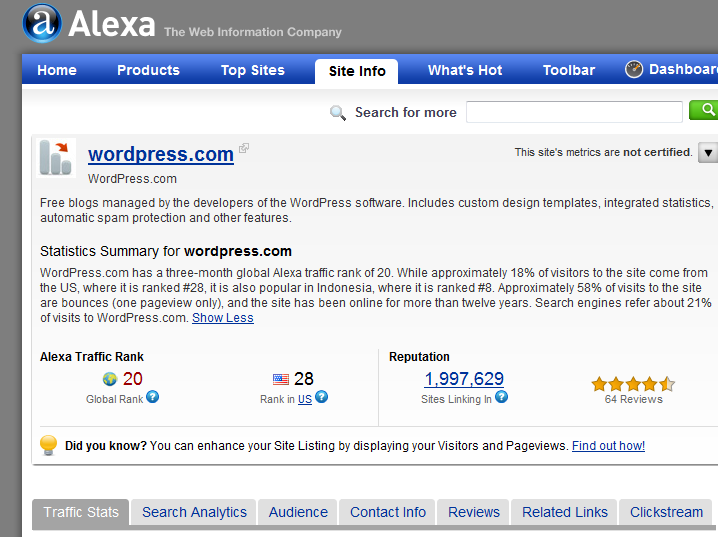
    Your Alexa ranking is a pretty good indicator of the popularity of your site. I always like to look at the global Alexa rank of a site, especially before I do business with them. Advertisers tend to look at these stats. If you are into any type of affiliate marketing you already know the importance of Alexa ranking as many affiliate marketers will do business with your blog based on your Alexa rank. Alexa will also give you other important statistics such as your rank in a particular country, traffic stats and back links info.

    Formerly, it was essential to have an Alexa toolbar installed so that Alexa could track the number of visitors but in 2008, Alexa went through a major update and they claim that they no longer need to see an Alexa toolbar installed to calculate your global rank.

    Alexa provides traffic data, global rankings and other information on thousands of websites, and claims that 6 million people visit its website monthly.

    Alexa is good as a research tool as it also compares competitor sites and shows you:

    • How popular the site is compared to yours, including Reach, Pageviews and more.
    • Search Analytics that indicate which terms your competition is using to get traffic.
    • Audience data such as what kind of visitors your competition is attracting.
    • Clickstream data that indicate where your competition is getting traffic from affiliate programs and partners.

    Alexa ranking
    Alexa ranking for WordPress.com, the popular blogging platform

    #2. Seo mozRank

    mozRank is measured on a scale of 1 to 10 and is SEOmoz’s 10-point measure of link authority and popularity. It’s similar to the old Google Page Rank and is logarithmic. That means it’s ten times as hard to move from a 3 to a 4 as it is to move from a 2 to a 3. Google Page Rank is no longer an accurate measure. It’s updated very infrequently and new sites are not given an API Soap key that is used by Google to effectively determine Page Rank.

    Each link back counts as a vote for your site and search engines often rank pages with higher global link authority ahead of pages with lower authority. Measures like mozRank are global and static, hence, this ranking power applies to a broad range of search queries, rather than pages optimized specifically for a particular keyword.

    It’s a good idea to have the MozBar installed as you will see your rank and also immediately know the rank of any site you visit. OpenSiteExplorer, another popular tool by Seomoz also gives you your mozRank(mR) along with other factors such as page authority(PA) and domain authority(DA).

    #3. Marketing Grader tool by Hubspot

    Are you doing enough to bring visitors to your website and fill the top of your sales and marketing funnel? How do you do when it comes to converting traffic into leads and leads into customers? Do you know what marketing activities are working?

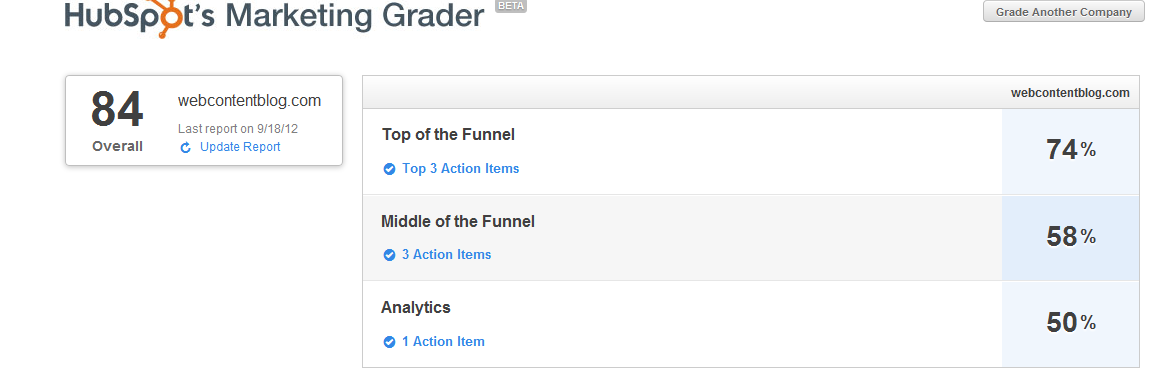
    I like Hubspot’s Marketing Grader tool because it points out exactly my areas of improvement based on reviewing over 30 factors and then providing me with an overall marketing grade on a 0-100 scale.

    The Marketing Grader tool studies over 30 different parameters including popularity metrics such as:

    • Are your marketing efforts generating sales and leads?
    • Is your blog driving results that justify the time investment or are you wasting time doing the wrong things?
    • Your mozRank and your Klout score
    • Your analytics and monthly web traffic
    • How effectively are you using social media to drive traffic to your website?
    • What are the strong points and suggestions for improvement in your marketing strategy?

    Social Search
    Maketing Grader report for Web Content Blog showing me different areas for improvement

    #4. Analytics

    Analytics software such as Google Analytics, Omniture analyse different metrics such as:

    • Number of page views, visitors, pages per visit, new visitors vs. returning visitors
    • Most popular posts based on number of page views
    • Most shares on social media
    • Other metrics such as demographics – visitors by geographic location, language spoken etc.
    • Metrics that measure engagement such as time on site and bounce rate.

    #5. Social Media

    In the current climate, your website’s popularity is also gauged by the number of times your site’s content is shared on social media. Your site is naturally more popular the more times it is shared on social media. Each share, like, tweet, reddit is counted by search engines as a vote for your site’s content and social shares are an important way for search engines to determine the popularity of your website.

    Sites such as Topsy do a good job of showing which post/page of your website content got the most shares. I also like url shorteners such as bit.ly that tell you how many times a piece of content was shared and by whom. I also like tweetmeme which shows you the hottest links on Twitter. Social Overview and Social Sources section of your Google Analytics are also pretty strong indicators of your site and content’s popularity. Of-course you can also get various paid solutions such as Radian6 to monitor social media analytics.

    If your website has a blog, there are certain other indicators such as your site’s RSS feed subscriptions and number of email subscribers that that give you an idea on your blog’s popularity. Even though fewer people subscribe to RSS feeds and RSS feeds are mainly subscribed to by readers who are already technically savvy, you could get some idea by checking your Feedburner stats or by checking your RSS feed stats through Google Reader. The number of email subscribers and also the type (profession etc.) of email subscribers could give you an indication of which niche market your blog is best aimed at.

    How about you? Which tools do you use to measure the popularity of your website and also why do you measure popularity? to gain more business? write better content? Please share in the comments below. Thanks.

    You May Also Like:

    7 Essential SEO Tools for All Content Writers
    5 Content guidelines that Attract Customers and Search Engines
    10 Free SEO Tools

    Filed Under: Seo Tagged With: alexa, global rank, hubspots market grader tool, measure site's popularity, mozrank, ranking of site, seo

    Is Social Media the New SEO?

    September 10, 2012 by Gazalla Gaya

    “SEO is Dead” – was the the trending topic in one of my LinkedIn groups last month. This discussion was in response to a Forbes article, “The Death Of SEO: The Rise of Social, PR, And Real Content.”

    The author, Ken Krogue, makes the case for social media being the new seo:

    “Google used to think if you linked to someone on the Internet they must have valuable content. Now Google seems to believe that if you promote content with social media it is more indicative of relevant content and less likely to be faked. It is hardly about the links anymore, it’s about the metrics of engagement on your site.”

    Does this argument hold true? Has social media so changed the seo landscape that social shares are most important and do other seo strategies even count?

    To understand the rising importance of social media on search, let’s backtrack to two interesting developments to Search:

    1. The launch of Social Search (Content that is shared within your social networks is given priority) and
    2. The general inclusion of social signals in rankings (The amount of likes, shares, reddits etc. that an article receives has a direct impact on its rankings).

    Google launched Social Search in 2009, as a feature that combines regular search results with publicly available data created by your friends’ social media activities. To use Google Social Search, simply do a search while logged in.

    In Dec 2010, Danny Sullivan’s famous article, What Social Signals Do Google & Bing Really Count? caused a buzz in the SEO industry. He wrote about social signals and their importance in ranking an article. Social signals are signals that search engines look for from popular social media sites. They look at metrics such as how many people share a piece of content, how many tweets, likes, redditts etc. did a given piece of content get.

    That same month, Matt Cutts confirmed that Google has incorporated social signals in ranking articles but is also considering the author who is posting the content. In other words, they give more weight to an influencer posting your content.
    Here’s the video:

    According to this video, we know that:

    • Google uses Twitter and Facebook links as signals in rankings. Social media likes, shares, tweets, reddits, and 1+’s (Googles obvious favorite) are regarded as votes for your site and your content.
    • The reputation of the author who is sharing the content is very important.
    • It’s currently (in Dec, 2010) used more in real-time search, but Google is looking to include it more broadly in web search as well
    • It only includes data that can be crawled and indexed. In other words private Facebook wall posts that cannot be crawled will not be indexed as opposed to Facebook fan pages that can be crawled.
    • Google ranks articles based on the quality of followers sharing your content. In other words they want to make sure that these are not just software bots but real people sharing your content.

    Based on our own experience as authors and publishers of content, we know that social media plays a role in influencing search engine results by giving preference based on the authority of the author and the number of times a piece of content is shared on social networking sites. Social search is also more prevalent and no more just a part of real-time search with the new updates this year.

    In early 2012, Social Search was given a major update. Google launched “Search, plus your World,” where it combined Google+ pages that were made public by its users with its regular search engine. You get personal results including photos uploaded by you or your connections, Google+ content, Google+ profiles and people and brands related to your search. Google +1’s are most easily indexed by Google and always show up prominently in search results.

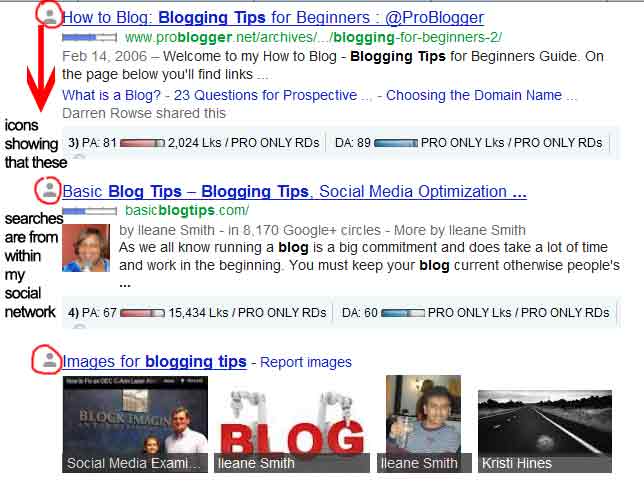
    The graphic below highlights a perfect example of Social Search in action. I follow Darren Rowse of Problogger and Ileane Smith of Basic Blog Tips. I typed in a search for “blogging” and their results showed up at the top of my search page:

    Social Search
    Social Search where people in my social network are given a priority in search results

    Fast forward to June, 2012 and Matt Cutts conversation with Danny Sullivan in which he elaborated that even though social signals are important, backlinks are still important and count as a vote for your website.

    Here is the video:

    Danny Sullivan and Matt Cutts discuss SEO at SMX Advanced, June 2012
    Here are the highlights of the conversation:

    • The web is comparable to space in it’s vastness and is currently the largest source of data in the world. For example, YouTube gets 72 hours of video uploaded every minute.
    • There is a perception in people’s minds that everything will go social which at this point is a premature assumption.
    • In Matt Cutts own words, “In 10 years things will be more social but I wouldn’t write the epitaph for links quite yet.”

    Backlinks still very much count as a vote for your site. But as Cutts reiterated it’s not just any backlinks but backlinks from authority sites that count the most.

    Google currently uses over 200 signals to rank a page including:

    • Page Rank
    • High quality and original content
    • Number of backlinks
    • Anchor text
    • Keywords
    • HTML title tags

    No sooner did Google announce the importance of social shares, than spammers started flooding the internet with offers for facebook likes, twitter followers, etc. and now for the price of a few dollars, you can buy fake Facebook likes, twitter followers etc. Plus 1’s are a little harder as Google requires you to verify your account before you open. Just as black-hat seo’s in the past used various spammy backlinking techniques, these social media spammers have muddied the waters of social media popularity. As long as spammers and people trying to game the system exist, Google will not be able to use only one method for rankings.

    Although social media is rapidly increasing as a way to understand relevance and context, we’ve heard from the horse’s mouth that it’s not the only way. The bottom line is that every seo strategy needs to account for a good social media policy while also keeping all the other strategies in mind such as gaining quality backlinks (through posting the best content, guest posting and commenting on other blogs), sound keyword research and optimizing your HTML tags and metadata.

    Do you agree or disagree? Please share your thoughts in the comments below.

    You May Also Like:
    7 Essential SEO Tools for All Content Writers
    How to Use the Magic of Meta Tags to Improve Your Rankings
    5 Content Guidelines that Attract Prospects and Search Engines

    Filed Under: Seo Tagged With: improve rankings with social shares, increase in social shares, matt cutts, seo and social media

    • « Previous Page
    • 1
    • …
    • 4
    • 5
    • 6
    • 7
    • 8
    • …
    • 11
    • Next Page »

    Free Email Updates

    Receive free updates on the latest in digital marketing.

    About Content Trends

    Content Trends covers the entire spectrum of content marketing. Get tips sent to your inbox on content marketing strategy, content writing, SEO, blogging and social media. Learn more

    Copyright © 2026 · Metro Pro on Genesis Framework · WordPress · Log in